Five Countries, One Finding: What Young Migrants Need Most Is Precisely What Systems Struggle to Provide

When an unaccompanied minor aged 16 arrives in Europe, a complex mechanism of institutions, laws, and professionals is set in motion. Reception centres assess their needs. Social workers develop integration plans. Guardians are appointed. Youth programmes offer language courses, mentoring, creative workshops. On paper, the system works.

In practice, something different often happens. The young person tells their story to one service, then retells it again to the next. A carefully designed support plan is lost when they are transferred to a new region. At 18, the adult they trusted most — a guardian, a youth worker, a mentor — is no longer available. The safety net unravels precisely when it is most needed.

This is the central finding of the WP2 Comparative Map of BRIDGE, a transnational analysis that examined how youth inclusion and safeguarding systems function across five European countries: Germany, the Netherlands, Spain, Greece, and Italy. The research, carried out within Work Package 2 of the Erasmus+ BRIDGE project, compared national regulatory frameworks, identified recurring gaps, and mapped ten good practices with strong potential for transfer across different contexts.

What the Research Examined

The Comparative Map is based on five state-of-the-art analyses produced by the partners and ten good practice fact sheets (two per country). Each country was examined through a common analytical framework structured around seven dimensions: governance and accountability; access pathways from first contact to community participation; youth agency and participation structures; safeguarding and referral mechanisms; intercultural mediation and communication; digital environments and online risks; and the sensitive transition to adulthood at 18.

The five countries represent different positions within the European migration landscape. Germany and the Netherlands function primarily as destination countries with consolidated welfare systems. Spain combines destination dynamics with significant territorial variation in service delivery. Greece serves as a frontline entry point, often under strong operational pressure. Italy sits at the intersection of entry and destination country, with a solid legal protection framework for unaccompanied minors but persistent difficulties in the transition to adulthood.

Four Conditions That Make the Difference

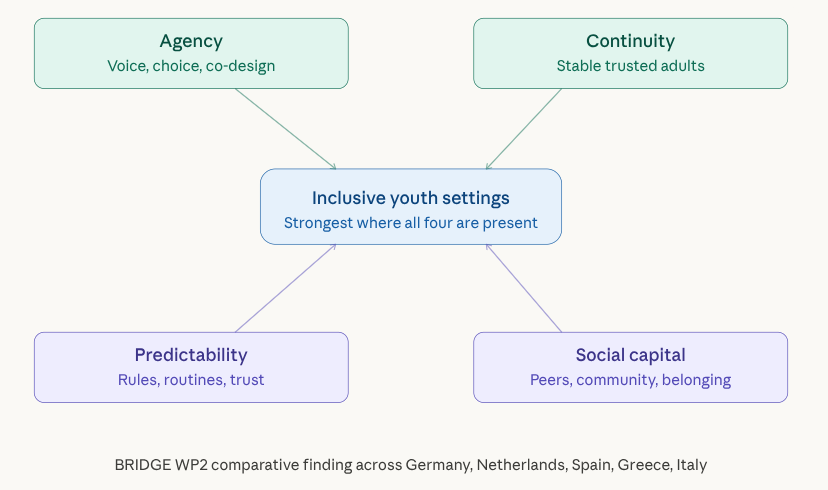
Despite these contextual differences, the comparative analysis reveals a significant convergence. Across all five countries, inclusive and preventive practices are strongest where systems deliberately build four protective conditions:

Agency — young people have a real voice in decisions that shape their daily lives and future pathways, not merely a seat at a table where adults speak on their behalf.

Continuity — a stable, trusted adult — a guardian, mentor, or youth worker — remains alongside the young person through transitions, sustaining not just a case file, but a relationship.

Predictability — transparent rules, stable routines, and clear expectations reduce the chronic stress of living within institutional uncertainty.

Social capital — connections with peers, community members, and trusted adults outside institutional settings create a sense of belonging that no programme can build alone.

Where these four conditions are present, young migrants are more likely to engage, to trust, and to build a future-oriented outlook. Where they are absent, systems produce the opposite effect: disengagement, distrust, and vulnerability to exploitation.

Five Cross-Border Pressure Points

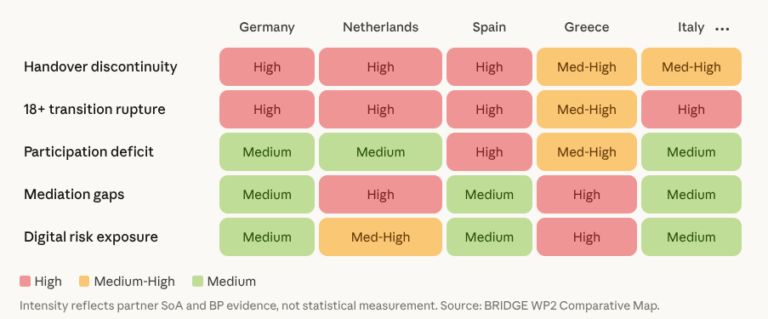
The Comparative Map identifies five systemic «pressure points» that appear, with varying intensity, across all five countries.

Discontinuity in transitions between competencies. Systems tend to be strong within individual sectors — reception, education, youth services — but fragile at the interfaces between them. When a young person is transferred from one service to another, support plans are often lost, referrals delayed, and stories retold from the beginning. The result is an erosion of trust that accumulates over time.

The transition at 18 as a systemic rupture. In every country examined, turning 18 leads to a reduction in available rights and support. Housing becomes precarious. Key relationships with trusted adults are interrupted. The risk of exploitation, informal work, and harmful peer networks increases sharply. Italy has proposed administrative continuity up to age 21, but the gap remains a structural weakness across all countries.

Participation that stops at presence. Youth participation is widely foreseen in legislation, but often translates into physical presence rather than real influence. When young people do not have a meaningful role in defining their routines, educational plans, and complaint mechanisms, disengagement is inevitable.

Gaps in mediation and role confusion. The distinction between interpreter and cultural mediator is often blurred. In the absence of clear role definitions, preparatory briefings, and confidentiality protocols, communication deteriorates — and meetings escalate conflicts rather than resolve them.

Digital risks that amplify offline isolation. The digital environment does not in itself create vulnerability, but it amplifies it when offline belonging is weak. Across all partner countries, young migrants are exposed to hate speech, online grooming, misinformation, and recruitment by harmful networks — risks that require constant attention from youth workers, not occasional awareness-raising campaigns.

Ten Practices, Five Transferable Mechanisms

Rather than presenting the ten good practices as isolated case studies, the Comparative Map groups them according to the protective mechanism they activate. This makes the evidence operational: it shows not only what works, but how it works and under which conditions it can be transferred.
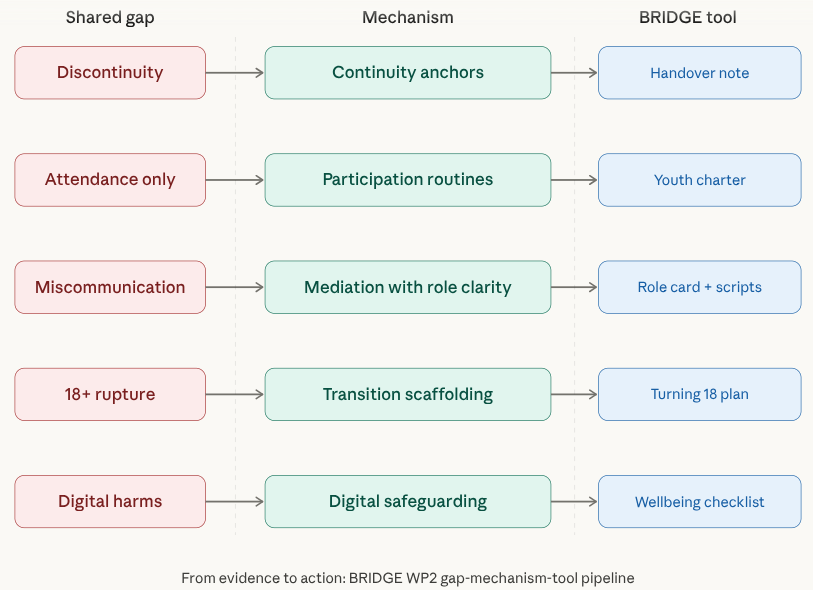
Continuity anchors and safe transitions of responsibility. Practices from Italy (the voluntary guardianship system for unaccompanied minors) and the Netherlands (intercultural mediation within guardianship coordination) show that a named reference person, a one-page transfer sheet, and a simple follow-up rule can prevent the worst effects of service fragmentation.

Participation routines that build agency. The German programme «Perspektive Zukunft» and the Greek peer-support model in Safe Zones show how co-created group charters, peer roles, and structured reflection can transform passive participation into active responsibility.

Intercultural mediation with clarity of roles. Dutch and Spanish practices highlight the value of simple, transferable tools: role sheets defining who does what, preparatory briefings for interpreters, and de-escalation indicators that reduce shame and “us versus them” dynamics.

Digital safeguarding and online resilience. Across all contexts, “regular digital wellbeing check-ins” during youth sessions, safe reporting channels for online harm, and scenario-based learning on misinformation prove more effective than occasional digital literacy workshops.

Structured support for the transition to adulthood. Practices from Germany, Italy, and Spain converge on the need for early transition planning — starting well before the eighteenth birthday — combined with continuity mapping beyond age 18 and a practical toolkit covering housing, education, employment, health, and legal status.

Inclusion Is a Matter of System Design, Not Individual Deficit

A cross-cutting theme in the Comparative Map is that young migrants and unaccompanied minors do not constitute a homogeneous group. Gender shapes vulnerability: young women face specific risks of harassment and gender-based violence, while caregiving responsibilities may exclude them from participation. Age and legal status create cumulative pressures, especially as the eighteenth birthday approaches. Language barriers require more than interpretation — they require plain-language communication, time for understanding, and protocols that safeguard consent. Psychosocial distress affects trust, memory, and the ability to disclose — making trauma-sensitive approaches essential, not optional.

The research frames accessibility as a system design requirement. When programmes are built from the outset with these differences in mind, they work better for everyone. When inclusion is treated as an add-on, the most vulnerable are the first to fall through the cracks.

Next Steps: From Evidence to Training

The Comparative Map is not an endpoint. Its findings feed directly into BRIDGE Work Package 3, which will develop training content and practical tools for youth workers, cultural mediators, guardians, and other professionals working with young migrants across Europe.

WP2 evidence identifies five priority competence areas for training: trauma-sensitive communication and empathetic listening; participation design and peer facilitation; intercultural mediation and conflict management; safeguarding documentation and referral pathways; and digital youth work with online safeguarding routines.

The ambition is practical. Each competence area will be translated into tools that professionals can use in their daily work: templates for transitions of responsibility, role sheets, digital wellbeing checklists, transition planning guides. The aim is not to describe good practice in the abstract, but to make it reproducible.

A Shared Challenge, a Shared Opportunity

The WP2 Comparative Map of BRIDGE tells a clear story. Across countries of entry and destination, across different governance models and legal traditions, the evidence converges: inclusion and prevention are strongest where systems deliberately cultivate agency, continuity, predictability, and social capital — and weakest where young people face discontinuity in service transitions, participation deficits, and ruptures in the transition to adulthood, increasingly amplified by digital risk environments.

These are not problems that any single country can solve alone. But they are problems that a shared European approach — grounded in comparative evidence and tested mechanisms — can begin to address. This is the purpose of BRIDGE: not to reinvent youth work, but to equip those who deliver it with better tools, clearer evidence, and the understanding that what works in one context can be adapted to another.

About BRIDGE

BRIDGE is an Erasmus+ KA2 Youth project focused on mediation, education, and the prevention of radicalisation among young migrants. The project consortium includes partners from Germany, the Netherlands, Spain, Greece, and Italy. Parsec Cooperativa Sociale (Rome, Italy) is a project partner contributing expertise in residential services for unaccompanied minors, community welfare, and intercultural mediation.

Scroll to Top