
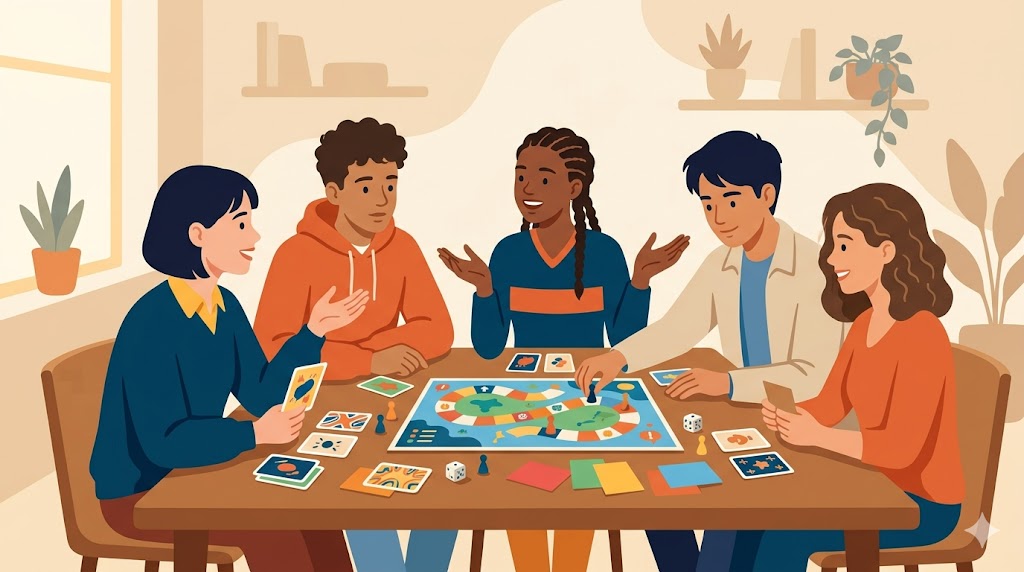
A boy who arrived a few months ago sits through formal interviews almost without speaking. A few weeks later, around a board game, he starts to talk about where he comes from and what he misses. Professionals in five European countries describe this scene in almost identical words, even though they work within very different reception systems.
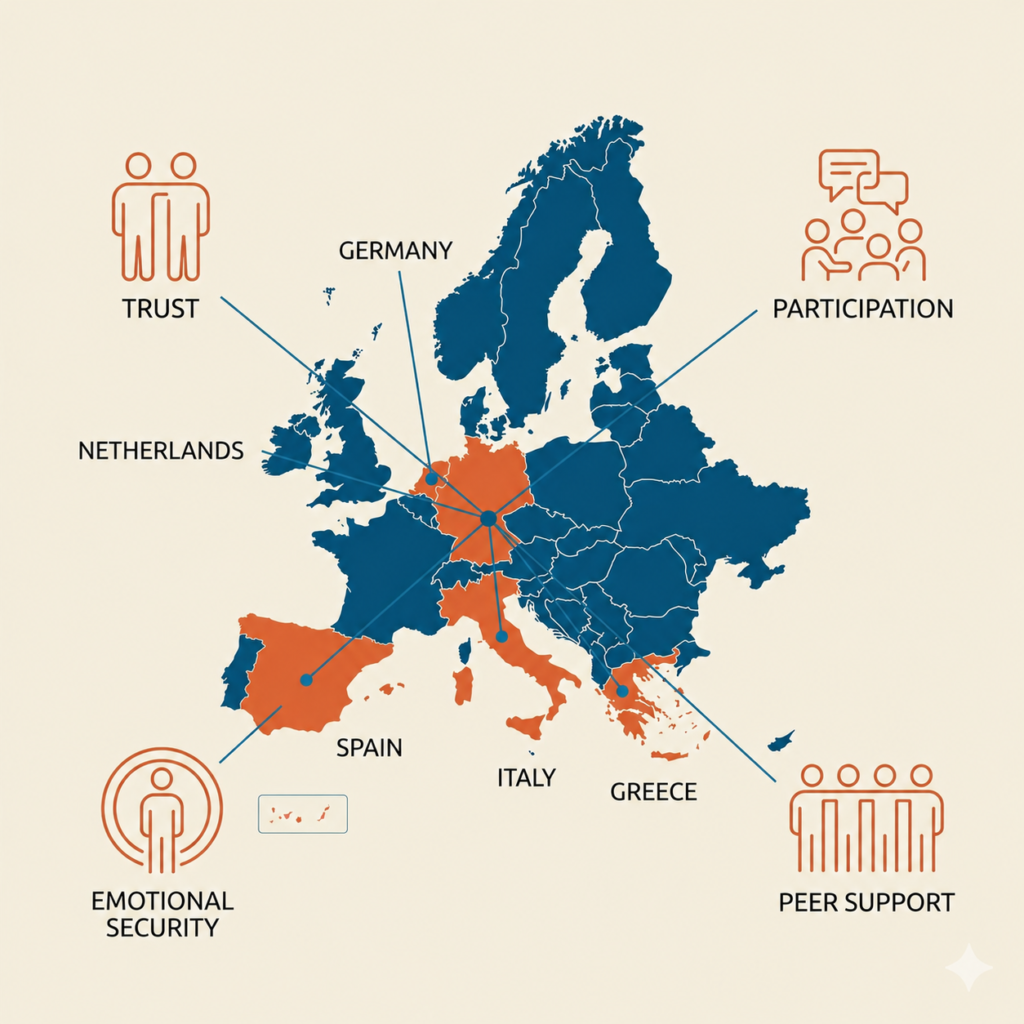
It is one of the findings of the training needs analysis carried out within BRIDGE, an Erasmus+ project bringing together organisations in Germany, Greece, Italy, Spain and the Netherlands that work with young migrants and unaccompanied minors. Parsec is the Italian partner. The research combined a staff survey with a series of focus groups: some with youth workers, cultural mediators, social workers, psychologists and coordinators; others with the young people themselves.
Where borders end, the answers converge
The first striking result is the convergence. Despite differences in language, legislation and the way services are organised, the conditions that allow a young person to trust and to take part turn out to be the same everywhere: continuity of the relationship, emotional safety, respectful communication, the presence of peers. Where these conditions exist, young people speak more, open up, stay in the group. Where they are missing, they withdraw. Staff report solid confidence in their listening skills, and at the same time acknowledge the difficulties they face when a conversation becomes emotionally intense, or when distress shows up as silence, irritability or disengagement.
The time a relationship needs and the speed systems demand
The second finding is a tension that returns in every country. The work that helps needs time, presence and consistency. The systems within which that work happens ask for documentation, speed and crisis response. On safeguarding, almost everyone says they can recognise a situation at risk. The difficulties come afterwards, with referrals that stall, pathways fragmented across different services, uncertain coordination. Awareness is not what is lacking. Continuity is. 
In Italy, the most recurring frustration concerns the transition to adulthood. When a young person who arrived at fifteen or sixteen turns eighteen, the system changes its rules and timelines while his life is still under construction. Those who have walked beside him for two years know this gap well, and experience it as one of the most fragile points in the whole journey.
Conflict does not come from hostility
There is also a reading of conflict that overturns a common assumption. In the accounts, tensions between young people rarely arise from hostility. They arise from stress, uncertainty about the future, language barriers, a sense of exclusion. This changes the meaning of prevention work. If tension grows out of exclusion, then preventing it means working on the quality of communication, on belonging to the group, on reducing distance. Emotional safety becomes an operational tool rather than an abstract value.
What young people ask for
Asked directly, the young people were clear about what matters to them: being listened to without judgement, being able to influence the decisions that concern them, feeling recognised. Many described peer relationships as easier to approach than adult-led structures, less hierarchical and emotionally safer. It is the same peer support that professionals struggle to organise while keeping safeguarding guarantees in place: a potential that is still under-structured.
On how learning and participation happen, the preference is clear across all countries. Games, storytelling, practical exercises, visual and collaborative activities work better than lecture-based formats. They lower anxiety, reduce language barriers, and make participation possible even for those with interrupted educational histories behind them.
National nuances remain. In Germany, intercultural mediation is the top training priority; in Spain, peer education tools come first; in Greece, safeguarding awareness is high, yet the demand for shared procedures is growing. Italy stands out for a strongly relational approach, built on observation and trust more than on procedure.
What guides the next steps
The findings point to a direction for the project’s next phases. Training for professionals will be built on simulations and practical tools rather than theory: managing difficult conversations, de-escalation techniques, facilitating peer groups, coordinating on safeguarding. Activities with young people will rely on co-design, on game and storytelling formats, on communication that stays accessible regardless of language level or educational background.
None of these indications is a recipe. They are directions that emerged from the daily work of those who stand beside these young people in five countries, to be tested, monitored and adjusted along the way. What the research says most clearly is where to look: the point where a steady relationship meets a system in a hurry. That is where it is decided whether a boy stays silent or begins to talk.